Newborns do not follow a schedule. They follow hunger. The numbers below describe what is common, so you know roughly what to expect.
01Start with hunger cues, not the clock
Feeding on cue is the standard advice for newborns. Early hunger cues:
- stirring or waking and looking around;
- bringing hands to mouth;
- turning the head and opening the mouth (rooting);
- lip smacking or sucking on fingers.
Crying is a late sign. A baby who is very upset can be harder to latch or to feed calmly, so calm them first.
02How often, by age
| Age | Typical feeds in 24 hours | Notes |
|---|---|---|
| First days | 8 to 12 breastfeeds; formula roughly every 2 to 3 hours | Small amounts, often. Milk comes in around day 3 to 5. |
| 2 to 4 weeks | 8 to 12 for breastfed; about 7 to 9 for formula-fed | Feeds may cluster in the evening. |
| 1 to 2 months | About 7 to 9 | Some babies start a longer stretch at night. |
| 3 to 5 months | About 6 to 8 | Feeds are often faster and more predictable. |
| 6 months and on | About 4 to 6 milk feeds plus solids | Start solids when your clinician says your baby is ready, usually around 6 months. |
These are typical patterns, not rules. Some healthy babies feed more often, and cluster feeding (many feeds close together) is normal, especially in growth spurts.
03How much, roughly
Breastfeeding: you cannot measure amounts, and you do not need to. Feed on cue, and watch the signs below.
Formula: a common guide is about 30 to 60 ml (1 to 2 oz) per feed in the first weeks, rising to roughly 120 ml (4 oz) by around 2 months and 180 ml (6 oz) by about 4 months. Babies vary, so treat this as a range, never a target. Stop when your baby shows signs of being full, such as turning away or slowing down.
Amounts depend on your baby’s weight, age and health. If your baby was small, early, or has any feeding concern, your doctor or midwife will give you numbers that suit them.
04Is my baby getting enough?
The most reliable signs are:
- Nappies: from about day 5, usually at least 6 heavy wet nappies a day, plus regular stools (see our nappy chart).
- Weight: most babies lose a little in the first days, then regain birth weight by around 2 weeks.
- Behaviour: alert when awake, and settled for a while after most feeds.
05When to call someone
- Fewer wet nappies than expected, or dark, strong-smelling urine after the first days.
- A baby who is very sleepy, hard to wake for feeds, or weak when feeding.
- Poor weight gain, or yellow skin that is spreading or getting deeper.
- Pain with breastfeeding that does not improve, or a latch you are worried about. A midwife, lactation consultant or health visitor can help quickly.
06Writing it down
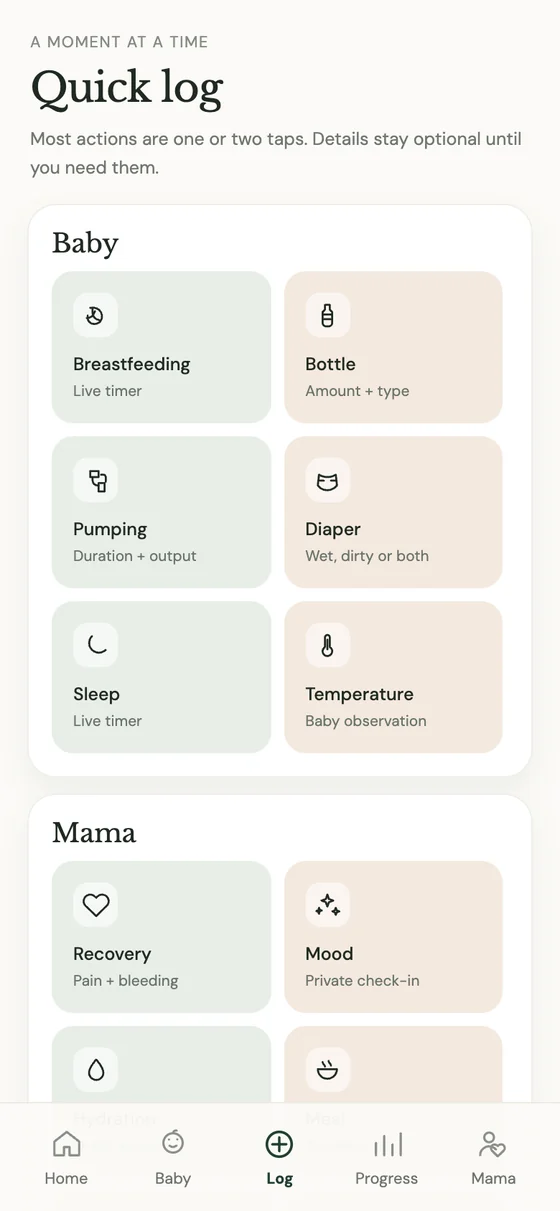
Most parents cannot remember at 4 a.m. whether the last feed was on the left side or the right, or how long ago it was. A simple log gives you the answer and gives your doctor useful facts. Kukumuma has one-tap feed timers for breast, bottle and pumping, and your partner sees every entry on their phone.
07Quick answers
How often should a newborn feed?
Breastfed newborns commonly feed 8 to 12 times in 24 hours. Formula-fed newborns often feed every 2 to 4 hours. Feed whenever your baby shows hunger cues.
How much formula does a newborn need?
Very roughly, 30 to 60 ml (1 to 2 oz) per feed in the first days and weeks, rising gradually. Follow your clinician’s advice and your baby’s cues, and the guidance on your formula tin.
How do I know my baby is getting enough milk?
Look at wet and dirty nappies, weight gain, and whether your baby seems satisfied and alert after feeds. If you are unsure, ask your midwife or health visitor to check.
This guide is general information and does not replace advice from your doctor, midwife or health visitor. Guidance changes and differs between countries, so follow your own health service. If you are worried about your baby or yourself, call them. In an emergency, call your local emergency number.