Before birth, your baby lived in a noisy place. Steady shushing sound is not a trick. It is familiar, and for many babies it helps.
01Why steady sound calms babies
The womb is not silent. Blood flow, your heartbeat and your voice create a constant whoosh. A low, steady sound can cover sudden household noises and help a baby switch off. “Shushing” works for the same reason.
Evidence that white noise makes babies sleep longer is limited, so treat it as a comfort tool, not a cure.
02The three safety rules: volume, distance, time
Aim for no louder than about 50 decibels at your baby’s ear, similar to a quiet conversation. If you have to raise your voice over it, it is too loud.
Place the speaker or machine well away from the cot, ideally two metres (around 6 to 7 feet), never inside it or clipped to the bars.
Use a timer so sound plays while your baby settles, instead of loud all night. Switch it off once your baby is asleep if you can.
These suggestions come from research that measured infant sleep machines, which found some could exceed workplace safety limits for adults at their loudest settings. A baby’s ears are more sensitive than ours, so we should be more careful, not less.
03Which sounds work best?
- Low shushing or “pink” noise is gentle and similar to the womb.
- Rain, ocean waves and a fan are steady and soft.
- A heartbeat or whoosh is also popular with newborns.
- Avoid anything sharp, with sudden changes in volume or melody. Steady is the point.
04Using a phone or an app
- Put the phone on a shelf or table away from the cot, never in it.
- Check that it plays with the screen off, so light does not disturb your baby.
- Use airplane mode or Do Not Disturb so calls and notifications do not interrupt the sound.
- Set a sleep timer.
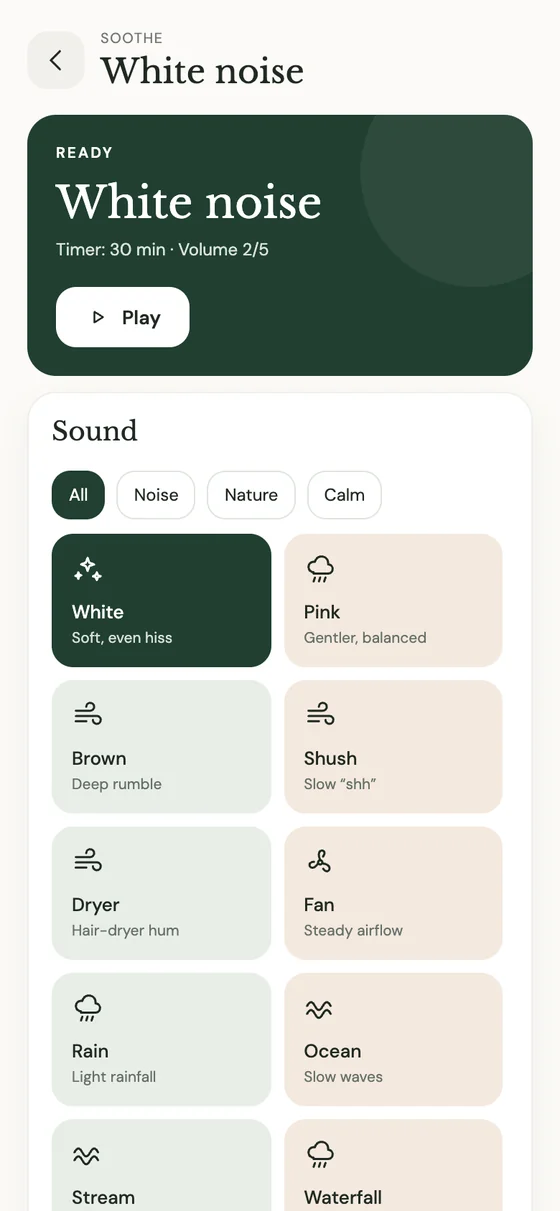
Kukumuma’s white noise and nature sounds keep playing with the screen off and have a timer, so you can set it and put the phone down.
If your baby is crying, check feeding, nappy, temperature and comfort first. White noise should never be used to ignore a baby who needs you, and safe sleep rules still apply.
05Will my baby become dependent on it?
Some babies do prefer it, and that is not harmful. If you want to reduce it, lower the volume a little each week and shorten the time. Most babies adapt in a few days to two weeks.
06Quick answers
Is white noise safe for newborns?
It can be, if it is kept at a low volume, placed well away from the cot, and not used at high levels for long periods. A 2014 study in the journal Pediatrics found that some infant sleep machines could reach unsafe levels at maximum volume.
How loud should white noise be?
Keep it quieter than a normal conversation. Researchers suggested staying at or below about 50 decibels at the baby’s ear. A free decibel meter app on a phone can check the level at the cot.
Can white noise be on all night?
It is safest to play it at a low volume and for limited periods, such as while your baby settles, rather than at high volume all night. Using a timer is a good habit.
This guide is general information and does not replace advice from your doctor, midwife or health visitor. Guidance changes and differs between countries, so follow your own health service. If you are worried about your baby or yourself, call them. In an emergency, call your local emergency number.