Crying is how a baby talks. Most of the time it means something simple. Sometimes it means nothing you can fix, and that is the hardest part.
01The eight-step checklist
When the crying starts, work through these in order. It takes a minute, and it stops you guessing.
- Hungry. Is it about 2 to 3 hours since the last feed? Early cues are lip-smacking, hands to mouth and rooting. Crying is a late sign.
- Wet or dirty nappy. Check it. A quick change often fixes it.
- Wind. Try burping on your shoulder or sitting upright for a few minutes after a feed. Cycling the legs can help gas move.
- Tired. Young babies can only stay awake for a short time, often 45 to 90 minutes in the early weeks. Yawning and staring away mean they are ready for sleep.
- Too hot or too cold. Feel the chest or back of the neck, not the hands. Add or remove a layer.
- Overstimulated. Too much light, noise and handling can overwhelm a newborn. A dim, quiet room helps.
- Wants closeness. Babies are used to the womb. A cuddle, skin-to-skin, a carrier or gentle rocking is a real need, not spoiling.
- Uncomfortable or unwell. A tight clothing tag, a hair wrapped around a toe, or signs of illness. See the warning signs below.
02The “hard evening” and what is normal
Many babies have a fussy period in the late afternoon and evening, even when nothing is wrong. Researchers describe a pattern where crying increases from around 2 weeks of age, peaks at around 6 to 8 weeks, then gradually improves by 3 to 5 months. It can be intense, hard to soothe, and sometimes happens for no reason you can find.
It does not mean you are doing it wrong. It is also not forever.
03Things to try when nothing is wrong
- Hold your baby close and walk slowly.
- Swaddle snugly if you have been shown how to do so safely, and stop once your baby shows signs of starting to roll.
- Sing, hum or talk low and steady.
- Use steady, low background noise at a safe volume (see our white noise guide).
- Go outside for a short walk, or to a different room.
- Take turns. A fresh pair of arms can sometimes work when yours have not.
04When you reach your limit
Crying that will not stop is exhausting. If you feel you might lose patience:
- Put your baby on their back in the cot, in a safe place.
- Step away for a few minutes, take slow breaths, and call someone you trust.
- Never shake a baby. It can cause serious, permanent harm.
Your baby is safe in the cot for a few minutes. It is okay to need a break.
05Warning signs: do not wait
Call your doctor or an urgent line straight away if crying comes with:
- a temperature of 38°C (100.4°F) or higher in a baby under 3 months;
- a cry that is weak, unusually high-pitched, or sounds different from normal;
- difficulty breathing, blue or very pale skin, or a baby who is floppy or hard to wake;
- repeated vomiting, green vomit, blood in the stool, or a swollen, hard tummy;
- refusing feeds or fewer wet nappies than usual;
- a bulging soft spot on the head, or a hard lump in the groin.
If your baby seems unwell to you, that is enough reason to call. You do not need to be sure first. In an emergency, call your local emergency number.
06How Kukumuma helps
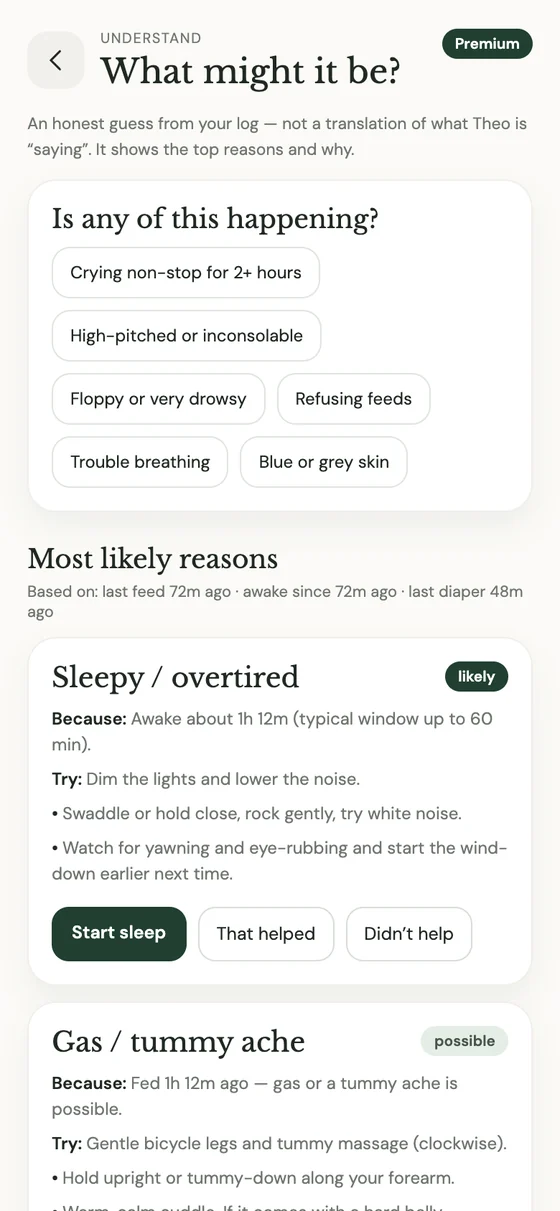
When crying starts at 3 a.m., it is hard to remember when the last feed was. Kukumuma keeps feeds, naps and nappies in one place, and the Why the crying screen suggests what to check next based on your baby’s own timeline. It is a prompt, not a diagnosis, and never a replacement for checking on your baby.
07Quick answers
How long can a newborn cry for?
Many healthy babies cry for a few hours a day in the early weeks, often more in the evening. Crying tends to rise from about 2 weeks, peak around 6 to 8 weeks, and ease by 3 to 5 months.
Is it okay to let my baby cry?
Newborns should be responded to. If you are overwhelmed, it is safe to put your baby on their back in the cot and step away for a few minutes to calm down. Never shake a baby.
Can a cry monitor tell me why my baby is crying?
No tool can know for certain. In Kukumuma, the cry monitor can suggest likely reasons based on timing and how the cry sounds, but you always know your baby best.
This guide is general information and does not replace advice from your doctor, midwife or health visitor. Guidance changes and differs between countries, so follow your own health service. If you are worried about your baby or yourself, call them. In an emergency, call your local emergency number.