“When did she last eat?” “Did he have his vitamin?” “Was that a wet nappy or a dirty one?” If this is your house at 3 a.m., a better system will help more than a better memory.
01The real problem is information, not effort
Most newborn arguments come from one person holding all the facts in their head. When only one parent knows the last feed time, they become the manager, and the other becomes the assistant who asks.
The fix is boring and works: put the facts somewhere both of you can see them.
02Split the night into two shifts
- Shift A covers, say, 9 p.m. to 2 a.m. while the other sleeps with earplugs in another room.
- Shift B covers 2 a.m. to 7 a.m.
- Swap the shifts every few nights, or whenever one of you is more tired.
- If one parent is breastfeeding, the other does everything else around the feed, from bringing the baby to winding and resettling afterwards.
A single block of five or six hours of real sleep does more good than four broken ones.
03Share jobs, not just babysitting
A baby creates a lot of work around them. Split these as well:
- Meals, shopping and cleaning.
- Laundry, including tiny clothes.
- Appointments, vaccine dates and calling the doctor.
- Keeping the nappy bag and changing station stocked.
- Telling relatives and visitors what you need.
Pick an owner for each. Owning a job means remembering it too.
04A handover that takes ten seconds
Before you hand over the baby, the next person should be able to see:
- Time and side or amount of the last feed.
- Last nap and how long it was.
- Last nappy.
- Medicines or vitamins given today.
- Anything unusual, like a cough or a rash.
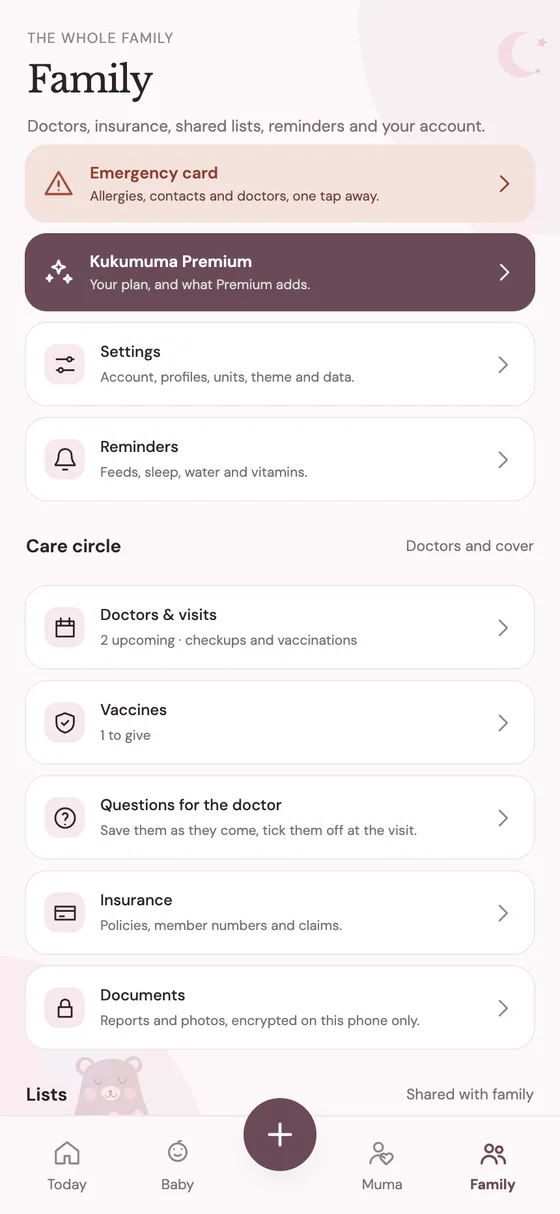
In Kukumuma, every entry appears on every family member’s phone within moments, with each person on their own login. Grandparents, nannies and carers can join the same baby too. The 3 a.m. quiz becomes a glance.
05Talk about it, when you are rested
- Do a five-minute check-in each day: what worked, what was hard, what do you need tomorrow?
- Say specific things: “Could you take the 2 to 7 shift tonight?” works better than “I need more help.”
- Thank each other for the small things.
- Do not keep score of who is more tired. You both are.
Around 1 in 10 new fathers and partners experience low mood or anxiety after a baby arrives. If your partner, or you, seem very low, anxious or not themselves for more than a couple of weeks, please speak to a doctor.
06Quick answers
How can partners share night feeds?
Split the night into two shifts, so each person gets one long stretch of sleep. If you breastfeed, a partner can handle changing, burping and settling, or give an expressed bottle once feeding is established.
How do we stop arguing about who does more?
Put the jobs in a list, and agree who owns each one. Talk when you are both rested, not in the middle of a night. A shared log also shows what has actually been done.
Can grandparents and carers use a shared log too?
Yes. Anyone who looks after the baby can add entries, so a handover is a glance, not a conversation.
This guide is general information and does not replace advice from your doctor, midwife or health visitor. Guidance changes and differs between countries, so follow your own health service. If you are worried about your baby or yourself, call them. In an emergency, call your local emergency number.